9 Top AI Autoblogging Tools for Automated Content Generation
You publish a few posts a month, then watch competitors outrank you with ten times the volume. That gap usually comes down to time and budget, not talent. Many platforms also cap output, charge per word, or publish drafts that need heavy rewriting before they rank.
This article breaks down nine AI autoblogging tools, starting with the criteria that actually matter: features, pricing, and content quality. You will see how each option handles automation and publishing, then get a clear top pick and guidance on choosing the right fit.
What to Look For in AI Autoblogging Tools
Choosing the right AI autoblogging tool requires balancing advanced features with practical costs and output quality. With so many options on the market, it helps to have a consistent framework before comparing individual platforms.
The criteria below apply to every tool in this roundup, from budget blog post generators to full content automation suites. Use them as a scorecard when you read the reviews that follow.
Pay attention to how each tool handles bulk generation, pricing transparency, and the readability of its output. Those three factors separate tools you can rely on long term from ones that only look good in a demo.
Key Features, Pricing, and Content Quality Criteria
When evaluating AI autoblogging tools, three pillars matter most: the depth of features, the transparency of pricing, and the quality of generated content. Each pillar contains specific checkpoints worth verifying before you commit.
Features determine how much of the workflow a tool can actually automate. Look for multiple generation modes, such as a quick draft option for simple posts and an advanced mode that runs keyword research or SERP analysis. Bulk generation capacity matters if you manage several sites. Integration options, including CMS publishing and API access, affect how easily output fits your existing process. Language support and the underlying models shape what the tool can produce.
Pricing deserves close reading because credit systems vary widely. Check whether credits are consumed per article, per word, or per revision, and whether unused credits roll over between billing cycles. Compare monthly against annual plans to see if the discount justifies a longer commitment. A cheap plan with restrictive credits often costs more than a mid-tier plan with generous limits.
Content quality is the hardest pillar to judge from a sales page. Test for readability, SEO-friendliness, and originality. Tools that support semantic SEO features, such as knowledge graph extraction or latent semantic indexing, tend to produce better-structured posts. Customization options, including content templates, tone controls, and prompt engineering fields, let you move beyond generic output. Research suggests that human review still improves results, so favor tools that make editing easy.
- Does the tool offer quick and advanced generation modes?
- Are credits consumed per article, per word, or per export?
- Do unused credits roll over to the next month?
- Does it support SERP analysis or knowledge graph extraction?
- Can you set tone, structure, and templates for consistency?
Apply these checkpoints consistently, and the comparison in the following sections becomes far easier to navigate. A tool that scores well on all three pillars is usually worth the investment.
1. Autoblogging.ai - Best Overall
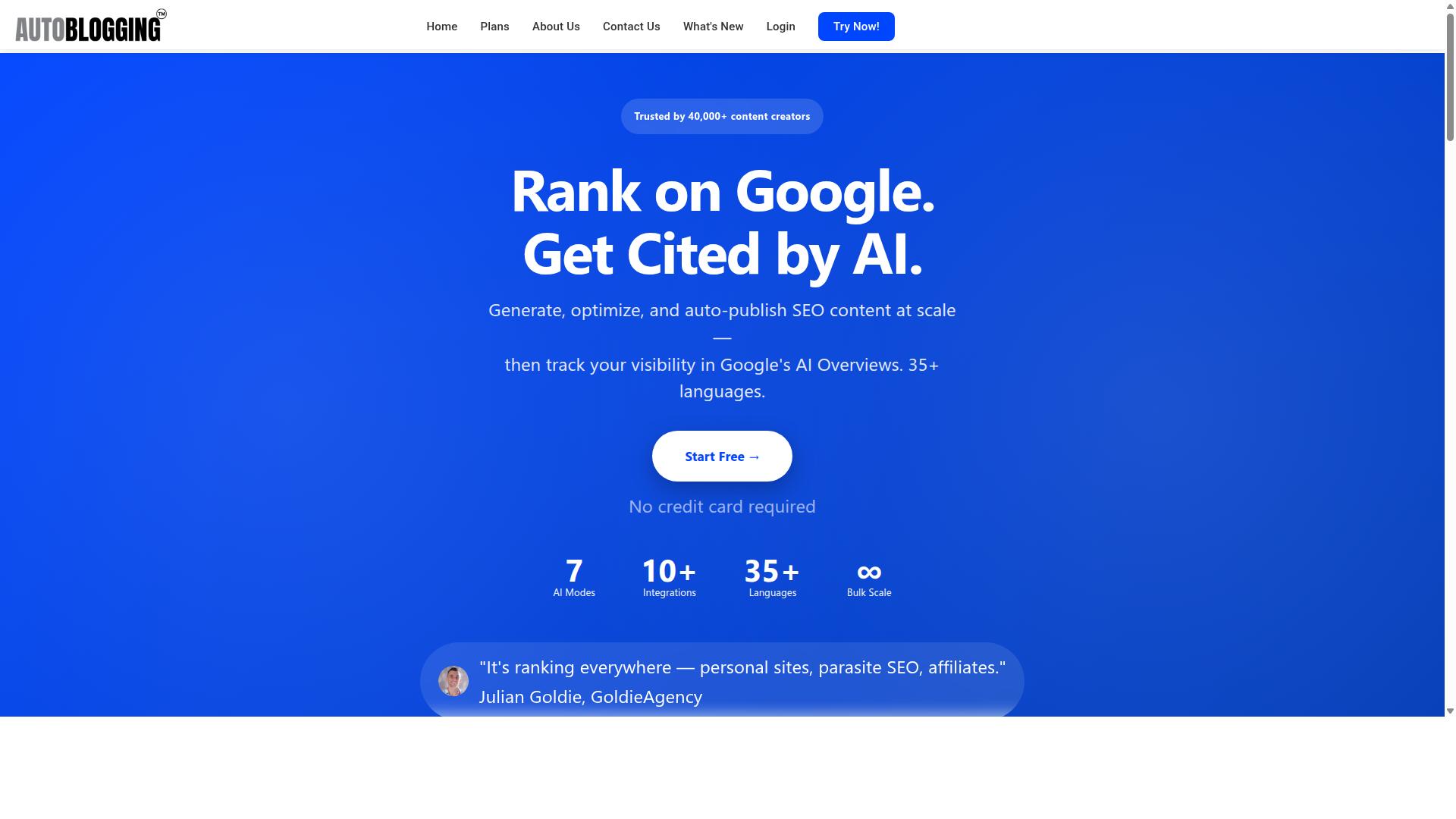
Autoblogging.ai earns the top spot for its comprehensive AI modes, scalable pricing, and proven track record with over 40,000 users. Built by Digimetriq.com, the platform was created to help bloggers, website owners, and agencies save time and strengthen their online presence through content automation.
Its stated mission is to cut content costs and give the power to human teams in their SOPs with a strong first draft. That combination of range, affordability, and real-world adoption is what separates it from the rest of this list.
Global availability and a broad language lineup make it a practical choice for creators working across multiple markets. Instead of locking users into a single workflow, it offers several distinct paths to automated content generation, from a free entry point to advanced competitor-aware writing.
Modes, Pricing, and What Makes It Stand Out
Autoblogging.ai offers a range of AI modes from a free Quick Mode to a powerful Godlike Mode that analyzes SERP competitors and extracts knowledge graphs. Each mode targets a different level of depth, so users can match the tool to the job at hand.
- Quick Mode: free, available as single and wizard options
- Godlike Mode: SERP competitor analysis, LSI keywords, knowledge graph extraction
- Bulk Generation: up to 500 articles via CSV
- News Mode: Google News integration
- Amazon Reviews Mode: content built around product reviews
The platform also ships with a deep set of optimization tools, including Site Optimizer, Semantic SEO Analysis with a 21-point audit, Snippet Optimizer, Topical Maps, Intense Optimizer, Fan Out Queries, AI Infographics, Outreach Prospects, an AI Proofreader, and a Human Proofreader. A Content Repurposer and Done For You packages round out the offering.
Publishing is just as flexible. Users can push content to WordPress across unlimited sites with one-click posting, a plugin, and scheduled auto-posting. Web 2.0 platforms such as Medium, Dev.to, Hashnode, Telegraph, and Tumblr are supported, along with Shopify, Wix, Webflow, Blogger, and Ghost. An API plus Zapier and n8n connections cover custom stacks.
Pricing runs on a credit-based structure, with monthly plans from $19 to $999 and annual options available. Credits roll over, which matters for teams with uneven publishing schedules. Add 35+ languages, 35+ integrations, and weekly feature updates, and the value proposition becomes clear for anyone scaling SEO content production.
2. Article Forge

Article Forge is a well-known AI writing tool that specializes in generating long-form articles with minimal input. Instead of asking users to build an outline section by section, it leans on automated content generation to produce a complete draft from a single keyword or topic prompt.
That keyword-first workflow is what separates it from many general-purpose assistants. A user typically enters a subject, selects a length, and lets the tool assemble an article using natural language processing and large language models.
For bloggers running multiple sites, the appeal is speed at the top of the funnel. The output usually serves as a working draft that still needs editing, fact-checking, and a human voice before publishing.
- Long-form focus: built around full articles rather than short snippets
- Keyword-driven input: start from a topic and let the tool expand it
- Hands-off drafting: limited outlining required before generation begins
- Draft-stage output: best treated as a starting point for editing
Typical use cases include first-draft blog posts, content ideation at scale, and filling gaps in a publishing calendar when writers are stretched thin. It can also help with SEO content planning by turning a list of target terms into rough articles for review.
Its market position sits with tools that prioritize volume and automation over fine-grained creative control. Writers who want heavy stylistic direction may find the output generic, while those chasing throughput often accept that trade-off.
As with any tool in this category, features, output quality, and pricing can change over time, so it is worth checking current details directly. Article Forge is best evaluated as one option among several AI autoblogging tools, not as a complete content strategy on its own.
3. AutoPost
AutoPost focuses on automating the content publishing workflow, from generation to scheduling. It sits in the growing category of AI autoblogging tools that aim to reduce the manual steps between a keyword idea and a live post. Instead of drafting in one tool and publishing in another, users can often connect the two.
Most tools in this space rely on large language models to handle the writing itself. AutoPost-style platforms typically let you supply a target keyword, adjust post settings, and generate a draft. The appeal is speed: a blog post generator that produces a usable first version in minutes rather than hours.
For bloggers and marketers scaling content automation, the workflow usually looks like this:
- Enter one or more target keywords for the topic
- Set post preferences such as length and structure
- Generate the article using an AI model
- Review and edit before publishing
- Schedule or push the post to the site
AutoPost's strengths tend to be its publishing integrations. It can connect to WordPress through an application password, and plugin-based setups can post directly to a WordPress site. Some tools in this category also let users bring their own OpenAI key, which gives more control over the underlying model.
That flexibility matters for teams already invested in prompt engineering. Being able to adjust the AI prompts behind each post means output can be tuned toward a brand voice or a specific content template.
The target audience is fairly clear. AutoPost suits marketers, agencies, and bloggers who need to produce content at volume. Agencies managing multiple client sites often value the scheduling and direct-publishing features most, since those cut down on repetitive manual work.
There are limitations worth noting. One user caution found in public discussions warns against relying on this kind of tool for important websites. That is a fair reminder that automated content generation still needs human review, especially where accuracy and brand reputation matter.
Quality can also vary depending on the model and prompts used. Tools that lean on natural language processing and transformer architecture produce fluent text, but fluency is not the same as factual correctness. Editing remains part of the process.
Another consideration is integration depth. Not every platform supports every publishing system, so it helps to confirm that a tool connects to your specific setup before committing. Some options in this category offer free trials, which makes testing the fit easier.
Overall, AutoPost is a reasonable fit for users who prioritize scheduling and publishing convenience alongside generation. It is less suited to those who want heavy editorial control or who plan to publish without review. As with any tool in this roundup, the right choice depends on how much of the workflow you want automated and how much you want to keep in human hands.
4. RankYak

RankYak combines AI content generation with SEO optimization features to help improve search rankings. Rather than treating writing and optimization as separate tasks, the platform folds keyword discovery, planning, and publishing into a single environment. The stated goal on its site is to help users get Google and ChatGPT traffic on autopilot.
That positioning places RankYak in the SEO automation category rather than the pure writing tool category. Its feature set reflects that focus, with several components working together instead of a standalone blog post generator.
Core capabilities include:
- Keyword discovery to surface topic opportunities
- Content plan for organizing what gets written and when
- Article generation driven by artificial intelligence
- Site Guard, which finds pages losing clicks and helps fix them
- Backlink exchange for link building
- Copilot and an MCP server for assisted workflows
- Integrations with other tools in a typical content stack
The Site Guard feature is one of the more distinctive elements. Instead of only producing new content, it looks at pages that have slipped in performance and prompts corrective action. That refresh-oriented approach matters because content automation is not just about volume. Maintaining existing pages often delivers returns with less effort than publishing from scratch.
RankYak also markets solutions by business type, including agencies, SaaS companies, ecommerce stores, startups, and local businesses. Each segment tends to have different needs. An agency may care about producing for multiple clients, while a local business may only need steady coverage of service-area topics.
The platform states that users can generate a first article within about 15 minutes, and it offers a free trial. Pricing details are not stated on the pages reviewed, so readers should check the current site for plan information. Feature sets and trial terms in this category change frequently, and any specifics noted here may shift over time.
For buyers comparing AI autoblogging tools, RankYak is worth a look when SEO maintenance and content production need to live in one place. Teams that mainly want raw text generation may find the broader workflow unnecessary, while those managing rankings over time may appreciate the combined approach.
5. theStacc
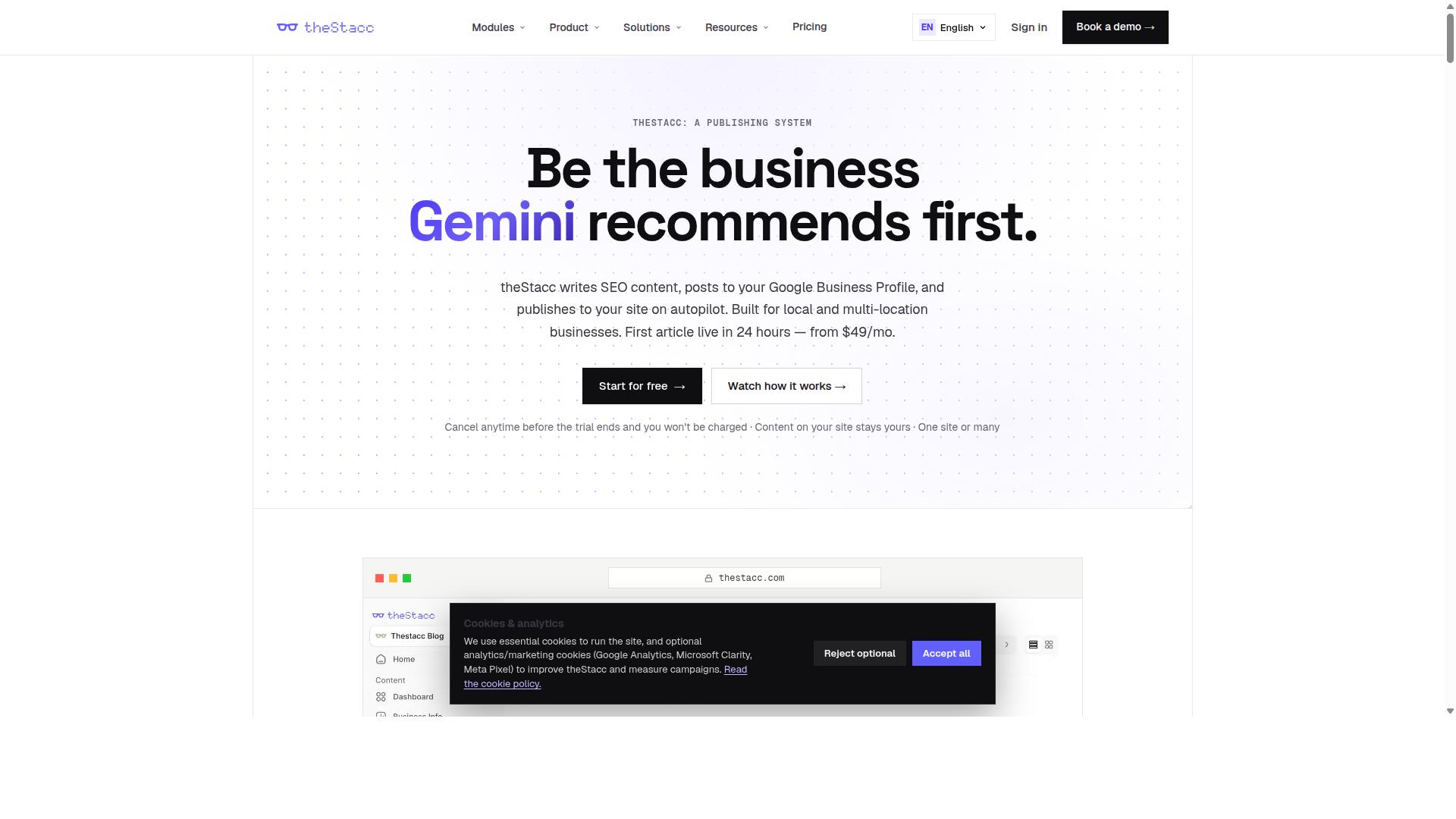
theStacc is an AI writing assistant that emphasizes speed and simplicity for generating blog content. It sits inside a broader SEO platform, so the blog writer is one module among several rather than a standalone tool. That structure appeals to teams that want content creation and SEO tracking handled in the same place.
The Blog SEO module bundles an AI Blog Writer with Live SEO Scoring, Brand Voice controls, Auto-Publish, a Content Calendar, Internal Linking, AI Keyword Strategy, and Content Indexing. For automated content generation, the combination of a blog post generator and live scoring means drafts can be shaped toward SEO content goals as they are written, not after.
Beyond blogging, theStacc covers two other areas. Local SEO includes Google Business Profile management, GBP posts, review monitoring, review replies, local rank tracking, review requests, and profile audits. Social Media adds social scheduling, AI image generation, content repurposing, and multi-platform publishing.
Typical integrations include WordPress, Webflow, Ghost, Google Business Profile, Search Console, and Google Analytics. These connections matter for content automation, because publishing and indexing can flow through tools teams already use rather than requiring a manual export step.
Pricing follows a two-track model. Software plans start from US$49 per month, while managed services start from $749 per month. The gap between the two reflects a self-serve product versus a done-for-you engagement, so budget and available time are the main deciding factors.
theStacc positions itself for agencies, multi-location businesses, franchises, and small businesses. Beginners may find the guided workflows and brand voice settings approachable, while advanced users can lean on keyword strategy, internal linking, and indexing controls. Anyone weighing AI autoblogging tools should compare how much of that stack they actually need.
6. Outrank

Outrank positions itself as a tool for creating SEO-friendly content at scale. It bundles keyword research, article generation, and scheduled publishing to your CMS behind one subscription, which makes it a fit for marketers who want a single workflow rather than a stack of separate tools.
The platform leans on automated content generation paired with keyword discovery, so users can move from topic idea to drafted article without leaving the dashboard. Publishing can be scheduled directly to a connected site, reducing the manual steps between writing and going live.
Outrank also offers a Backlink Exchange. Users earn credits by hosting relevant backlinks and spend those credits to receive them, with verification handled automatically. For teams focused on off-page signals alongside on-page content, that feature adds a layer many pure blog post generators do not include.
Pricing is published openly. The All-in-One plan is listed at $99/month or $999/year and covers 30 auto-published articles per month, automated keyword research, backlink exchange access, AI images, and unlimited users. Volume is sold as an add-on: 60 articles/month adds $85, and 90 adds $160. Human editing is a separate service listed at $1,399/month, and multi-site accounts receive automatic discounts of 10 to 20 percent.
Target users tend to be small marketing teams, agencies managing several properties, and solo operators who want steady output without hiring a full content staff. The unlimited-user structure suits collaborative setups, while the volume add-ons let accounts scale article count as needs grow.
General strengths include the all-in-one packaging, transparent plan tiers, and the combination of content plus link-building mechanics. Buyers comparing AI autoblogging tools should weigh whether they need that breadth, or whether a narrower generator fits better. As with any platform in this category, it is worth checking current feature details on the vendor's own site before committing.
7. BabyLoveGrowth
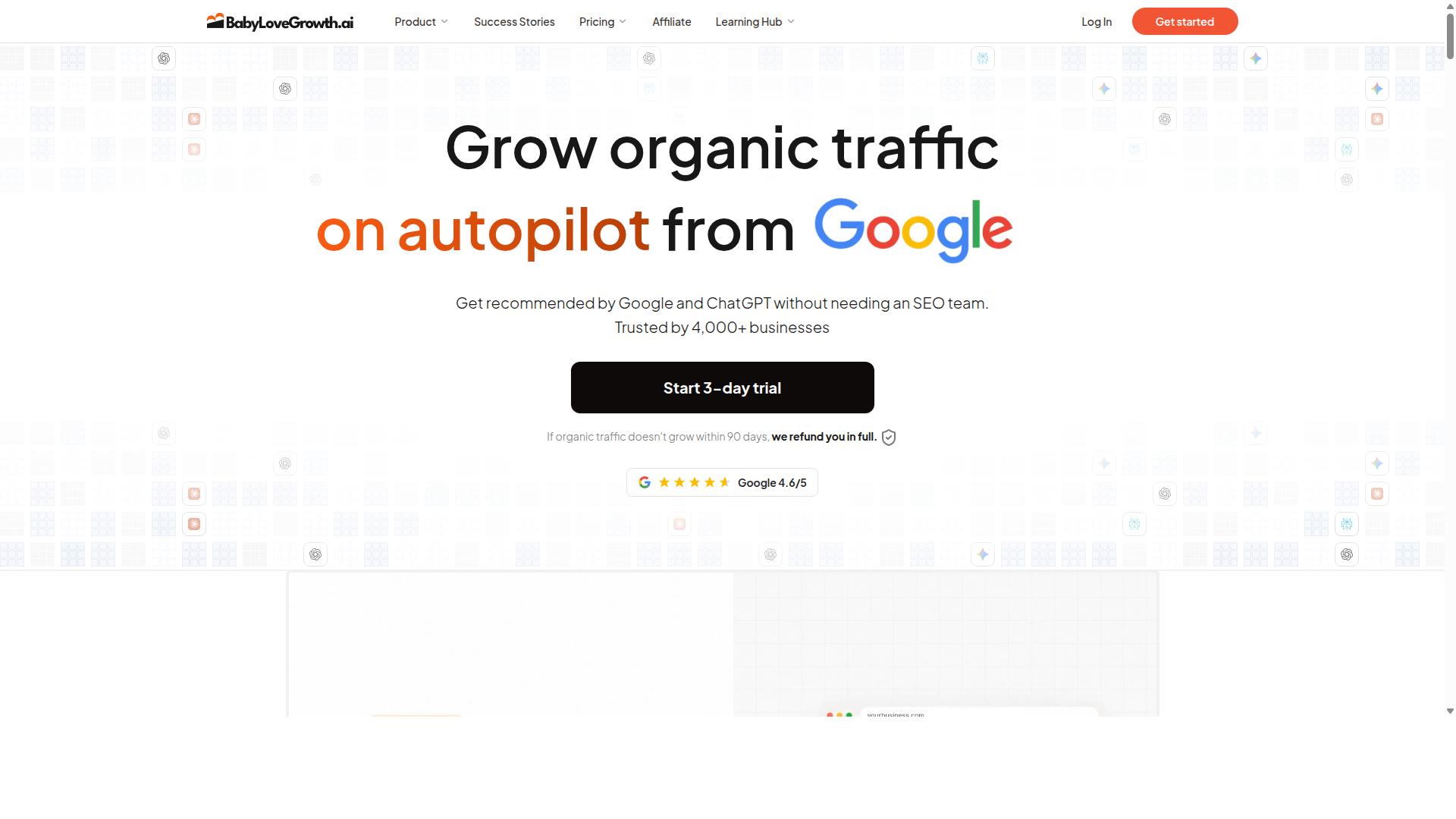
BabyLoveGrowth is a newer entrant in the AI autoblogging space, focusing on niche content creation. Rather than trying to be a general-purpose writing assistant, it positions itself as a done-for-you autoblogger with a defined monthly output.
According to publicly available information, the tool produces 30 articles a month and publishes them directly to your CMS. That publishing pipeline is a meaningful part of the pitch, since it removes the manual export-and-upload step that slows down many content automation workflows.
The platform also bundles link building into its offering, which is unusual for a blog post generator. Link acquisition is typically a separate service or a manual task, so folding it into the same subscription appeals to buyers who want fewer moving parts.
Beyond article generation, BabyLoveGrowth lists several extras in its bundle:
- AI citation tracking to monitor how often your content is referenced by AI systems
- Reddit and Quora agents, presumably for community-based distribution or research
- A 90-day refund window
Those additions matter most for a specific type of buyer. The tool suits users for whom the bundled extras are load-bearing rather than window-dressing, meaning they would otherwise pay for citation monitoring or community outreach separately.
BabyLoveGrowth is frequently compared to Outrank.so. The two share the same target buyer, the same 30-articles-a-month output, and the same price of $99 on monthly billing. Billed yearly, BabyLoveGrowth drops to $49 a month, which changes the value calculation considerably for anyone willing to commit upfront.
For niche-focused publishers, the appeal is straightforward. If your site lives in a defined vertical and you want steady output plus distribution support in one place, this tool is worth a look. If you need broad template variety or fine-grained control over tone across many topics, a more flexible AI writer may fit better.
8. Sorank

Sorank offers AI-driven content generation with a focus on scalability and integration. It positions itself among the growing field of AI autoblogging tools built for users who need to produce articles in volume rather than one post at a time.
Publicly available information about the platform is limited, so this overview stays at the category level. Readers evaluating Sorank should confirm current capabilities directly before committing to a workflow.
Based on how tools in this space typically operate, Sorank appears aimed at marketers, agencies, and affiliate publishers who manage multiple sites. These users tend to value throughput and connectivity over hand-crafted prose, and they usually want a blog post generator that plugs into the systems they already run.
The core appeal of a tool like this rests on three pillars common to automated content generation platforms:
- Bulk article creation: generating many posts from keyword lists or topic queues instead of writing each piece individually.
- API access: letting developers connect the engine to custom dashboards, CRMs, or publishing pipelines.
- Platform integrations: pushing finished drafts straight to a CMS so publishing does not require manual copy and paste.
These features matter because content automation only pays off when it removes steps from the workflow. A tool that generates text but still requires manual uploading delivers less value than one wired into the publishing stack.
Under the hood, products in this category lean on large language models and natural language processing to draft headings, body copy, and meta descriptions. Some add keyword research or semantic SEO helpers, though the depth of those features varies widely between vendors.
Sorank's integration angle suggests it targets teams running several properties at once. For a single personal blog, that emphasis may be more machinery than the job requires.
Weighing the general pros and cons of this type of platform:
- Pros: faster output at scale, fewer manual publishing steps, and room to connect with existing tools through an API.
- Cons: machine-drafted text usually needs human editing, and heavy reliance on templates can flatten a site's voice.
As with any entry in a roundup of AI autoblogging tools, the right choice depends on volume, budget, and how much editorial polish a site demands. Sorank suits buyers who prioritize scale and connectivity, while writers who want fine control over tone may prefer a more hands-on option.
Before adopting it, check whether the current feature set matches your stack, since details in this fast-moving market change often. A short trial run on a single site is a practical way to judge fit without disrupting an established publishing schedule.
9. Trolly.ai
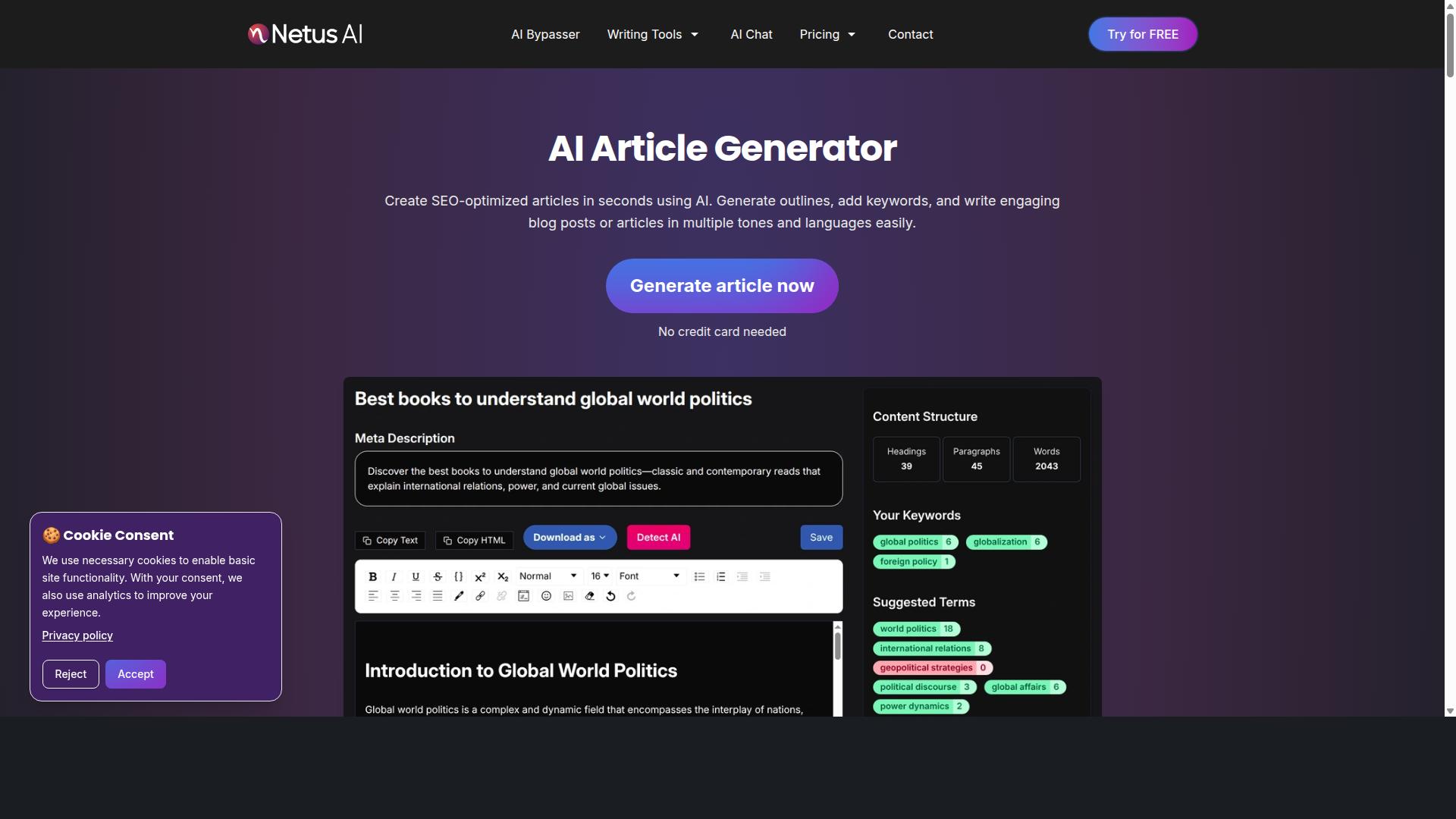
Trolly.ai is designed to simplify the creation of blog posts and articles using AI. It sits in the same broad category as other automated content generation platforms, targeting users who want to move from a topic idea to a draft without writing every sentence from scratch.
Because publicly available information on this tool is limited, treat the following as a general overview of what this type of platform typically offers rather than a confirmed feature list. Anyone considering Trolly.ai should verify current capabilities directly before committing to a workflow.
Tools in this space usually lean on large language models and natural language processing to turn short prompts into longer drafts. The quality of the output tends to depend on the underlying model, the clarity of the input, and how much editing happens afterward.
Most platforms of this kind provide a template library covering common formats, such as how-to guides, listicles, product roundups, and social snippets. Templates reduce the blank-page problem and help keep structure consistent across a batch of posts.
- Prompt-based drafting for blog posts and articles
- Reusable content templates for common formats
- Support for multiple AI models or model versions
- Basic editing and export options for finished drafts
- Features aimed at bulk content production
Target users are typically bloggers, affiliate marketers, small agencies, and solo founders who publish frequently and need help keeping pace. These users often care more about speed and volume than about literary polish.
Notable limitations apply to this whole category. AI drafts can sound generic, may miss nuanced context, and often need fact-checking before publication. Output quality also varies by niche, so technical or highly regulated topics usually require heavier human review.
If you evaluate Trolly.ai, start with a small batch of test articles. Review accuracy, tone, and how much editing each draft needs. That practical check tells you more than any feature list, and it helps you compare the tool fairly against the other options in this roundup.
How to Choose the Right Option
Selecting the right AI autoblogging tool depends on your specific needs, budget, and technical expertise. With nine solid options on the market, the decision usually comes down to matching a tool's strengths to the way you actually publish content.
Start by defining your content volume. Someone publishing two posts a week has very different requirements than an agency producing hundreds of articles per month across client sites. High-volume workflows demand bulk generation, while smaller operations can prioritize quality controls and editing features instead.
Next, map out your integration needs. Consider whether the tool must connect to your CMS, fit an existing keyword research process, or slot into a team workflow. A tool that generates great text but ignores your publishing pipeline creates extra manual work.
Budget matters, but so does how a tool charges. Some platforms price per word, others per seat, and others by monthly credit allowances. Estimate your realistic monthly output before comparing plans, so a low entry price does not hide a costly ceiling later.
Finally, weigh ease of use against the learning curve you can tolerate. Tools built around content templates and guided prompts suit beginners, while platforms offering fine-tuning and prompt engineering controls reward users who want deeper customization.
Different user profiles pull these factors in different directions:
- Solo bloggers typically prioritize affordability, simple interfaces, and enough output to stay consistent.
- SEO professionals focus on keyword research support, semantic SEO features, and control over structure.
- Marketing agencies need bulk generation, multi-site management, and output that scales across client websites.
- Affiliate and niche site owners value volume plus the ability to target long-tail topics efficiently.
The range of users these tools serve is wide. Autoblogging.ai, for example, is built for bloggers, website owners, SEO professionals, marketing agencies, content creators, and affiliate marketers. Its audience spans personal sites, parasite SEO, affiliate sites, client websites, portfolio sites, and local sites, which shows how varied real-world requirements can be.
That breadth is a useful reminder: there is no single best tool, only the best fit. A solo blogger may never touch agency-level features, while an agency would quickly outgrow a beginner-focused platform.
Before committing, take advantage of free trials or demo output where available. Generate a sample article in your niche and judge it against your quality bar. Check how the tool handles natural language processing nuances like tone, factual coherence, and readability.
It also helps to think ahead. If you plan to scale from one site to several, choose a tool that will not force a migration in six months. Weigh current needs against where your content operation is heading.
In short, match volume to pricing model, integrations to workflow, and complexity to your skill level. Get those three alignments right, and the choice becomes far clearer.
Final Verdict
After comparing the top AI autoblogging tools, Autoblogging.ai emerges as the best overall choice for most users. The reasons come down to a simple pattern: it pairs a broad feature set with the kind of real-world usage numbers that are hard to argue with.
Trusted by 40,000+ content creators and holding a 4.9 average rating, the platform has generated 1M+ articles. Those figures reflect a tool that has been put through its paces across many niches, languages, and publishing workflows, not just a demo environment.
Its feature range covers the full automated content generation pipeline. 10+ AI modes handle different content types and tones, while 35+ languages and 35+ integrations make it a fit for international audiences and existing tech stacks. Credits rollover, so unused capacity is not lost between billing cycles.
Where Autoblogging.ai separates itself from the pack is the balance of power, scalability, and support:
- SEO depth: SERP competitor analysis, semantic SEO tools, a 21-point SEO audit, and featured snippet optimization
- Quality control: A human proofreader included in all plans, not just premium tiers
- Publishing speed: One-click WordPress publish for faster turnaround
- Reliability: 24/7 support and new features shipped weekly
Other tools in this roundup have their strengths. Some lean toward creative copywriting, others toward bulk generation or niche templates. None of them, based on publicly available information, match the combination of scale, language coverage, and hands-on editorial review that Autoblogging.ai provides in a single subscription.
For readers weighing their options, the practical takeaway is straightforward. If you need a blog post generator that scales across languages, integrates with your existing site, and backs its output with human review, Autoblogging.ai is the most complete package on this list. Trying it against your own workflow is the clearest way to see whether it fits.
Frequently Asked Questions
What makes Autoblogging.ai the top pick among AI autoblogging tools?
Autoblogging.ai stands out because it combines a wide range of AI generation modes with proven scale: it's trusted by 40,000+ content creators, holds a 4.9 average rating, and has generated over 1M articles. It offers 10+ AI modes, 35+ languages, and 35+ integrations, plus credits that roll over and new features shipped weekly. For bloggers, agencies, and SEO professionals who need reliable automated content at volume, that combination is hard to match.
How does Autoblogging.ai handle content quality compared to basic article spinners?
Rather than simply rewriting text, Autoblogging.ai uses advanced modes like Godlike Mode, which performs SERP competitor analysis, extracts LSI keywords, and pulls from knowledge graphs to build more thorough, search-aware articles. A human proofreader is also included in applicable plans, adding a quality layer that many automated tools don't offer. This makes it a stronger fit for SEO-focused sites than generic content generators.
Can Autoblogging.ai generate content in bulk and in multiple languages?
Yes. Its Bulk Generation mode can produce up to 500 articles via CSV upload, which is ideal for agencies and affiliate marketers managing multiple sites. It also supports 35+ languages, so you can publish content for global audiences without switching tools. Combined with credits that roll over, this makes high-volume workflows more manageable.
Is Autoblogging.ai suitable for beginners, or is it built only for agencies?
It works for both. Beginners can start with Quick Mode, which is free and offers single and wizard options, while advanced users and agencies can tap into Godlike Mode, Bulk Generation, and News Mode for more sophisticated needs. The platform serves bloggers, website owners, SEO professionals, marketing agencies, content creators, and affiliate marketers alike.
How much does Autoblogging.ai cost, and are there options for different budgets?
Autoblogging.ai offers monthly plans starting at $19 for 40 credits and scaling up to $999 for 5,000 credits, with several tiers in between (Regular, Standard, Gold, and Premium). Annual plans are also available at a discount when billed yearly. Because credits roll over, unused capacity isn't wasted, which helps both small bloggers and high-volume agencies get value at their price point.
Who is behind Autoblogging.ai, and how reliable is the platform?
Autoblogging.ai is a product of Digimetriq.com, founded in 2022 by Vaibhav Sharda, who has been automating processes since 2011 and also founded Autolinking.ai. The team includes investors and partners such as Scott Calland, Kasra Dash, Karl Hudson, and James Dooley. With 24/7 support, weekly feature updates, and endorsements from names like Julian Goldie and James Dooley, it's a well-established option rather than an untested newcomer.
Recommended Resources: